Since Christmas it’s been settled; dry, sunny and cold. Some time Wednesday night I heard rain and come morning every surface was smooth glazed with ice. It was treacherous and to get to the neighbours’ I had to walk in the dry ditch.
On Thursday I put aside building to concentrate on the workshop’s water supply. To cut a now tedious story shorter, the shower stopped again after a day. I partly dismantled my latest outside plumbing, again, added the Big Blu 20″ 5-micron filter, rewrapped the pipes with the blue ethafoam off-cuts secured with brown parcel tape then further protected everything with unused slabs of the Isoquick foundation polystyrene – less messy than the wood fibre. It’s all a bit of a temporary bodge.

We then repeated the shower disassembly, an operation that now seems routine, though here tinged with a worry that the big new filter might lower the pressure enough to stop the shower working… I washed and blew the filter clean, put it all back together and switched on the electricity. At the push of the button the shower showered; good flow, good temperature; happy campers. That took us until lunch time after which I managed a bit more cladding. Only three long pieces remain to be cut and fitted to frame the last window and door (still ignoring the entire lean-to entrance).
Friday – holiday! The number of fortified settlements within ten miles of us is remarkable. Every other crag seems to be the site of a former defensive structure. Within half a mile of our plot there are two duns, a third across the water near the ferry terminal. A mile down the loch towards the sea a steep crag boasts three from different eras, two within the banks of another. Apart from the general intrigue some of these old structures are described as vitrified; could you tell by looking at them?
We set out to see one at Carradale, at the far end of a tenuous point on the other side of Kintyre, new territory for us and a beautiful drive on small roads. Because of the repeated frosts and the minor roads we were prepared to turn back at any point, but all seemed fine, not too icy. About halfway across Kintyre you see Arran across five miles of sea.

Thankfully there seemed to be no clear path to the fort. It was signposted from the road but after a car park by the beach you just had to make it up. Following the water’s edge worked well, picking our way across the turf between brackish pools where ice wafers floated.
The rocks were slaty, fine leaved and folded like wet paper.

We kept following our noses; the bay to our right, a high hummocky ridge to our left, and were surprised when the ridge came down to the sea, a pair of rocky beaches to left and right framing a sea weedy isthmus, at the end of which rose a final outcrop. That must be where the fort was though there was no sign of it and the map hadn’t prepared us to expect a sometime island. It seemed a great place to live in uncertain times.
We climbed the outcrop and found ourselves in an omelette pan of subtle walls, a stone ring-bank mostly grassed over, though here and there the rocks showed through. On case inspection there were indeed signs of melting and fusing…
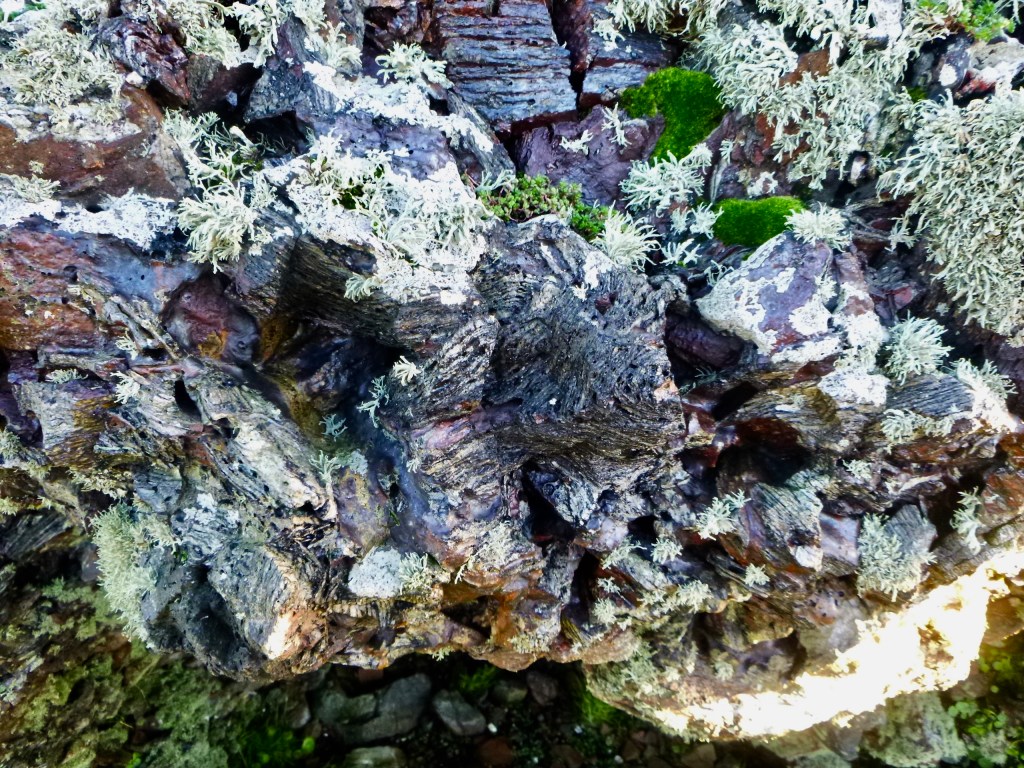
We sat for some time looking out to sea and when we descended found the isthmus under water (oops!) though thankfully not yet too deep for wellies.
Twelve miles further down the road we came to Kildonan Dun. ‘Undiscovered Scotland’ says it ‘is a remarkably well preserved dun, or fortified farmstead‘. In contrast to Carradale it’s much more modest and in a far less imposing location, but the thick walls still stand and feature internal stone stairs, a closed cell and an entrance shaped to accommodate a heavy door with holes for a bar to secure it.

We walked on from the dun, quarter of a mile to yet another fort on the next coastal point. Stones lay strewn around and in loose heaps but nowhere was there any standing remnant of wall, stone on stone. In one direction were the snow mountains of Arran and in another the upturned pudding basin of Alsa Craig, famous for its sixty four thousand breeding gannets and the micro granite used to make curling stones.


Saturday was a local mooching day but Sunday saw us back on the coast eight miles along the Kilberry Road, near Loch Caolisport (pronounced Killisport). Of course it has its standing stone (doesn’t everywhere?) but also a fort we’d not yet reached. The lower coastal fields are part pasture, part bog and part rock, all bordered by sand and sea.
Where possible we walked along the sand and early on saw a large bird flying low up the coast towards us. We took it in turns to watch through binoculars. The bird flew on past us, perhaps a hundred metres out to sea, then spiralled back, a few flaps and a glide into the wind, gradually gaining height as it circled, drifting back the way it had come, getting higher, growing smaller. At some point our attention faltered and it was gone, probably having gained enough height to set course for wherever it wanted to be. There was no sign of any white plumage but I must admit I didn’t pay attention to the shape of the tail. I think it was a golden eagle – square tail end – rather than a white tailed eagle – tapered tail end. Attention will ne More focused next time.
Then we came across boot prints, made since the tide had fallen, ie within a couple of hours, and then more interesting prints…
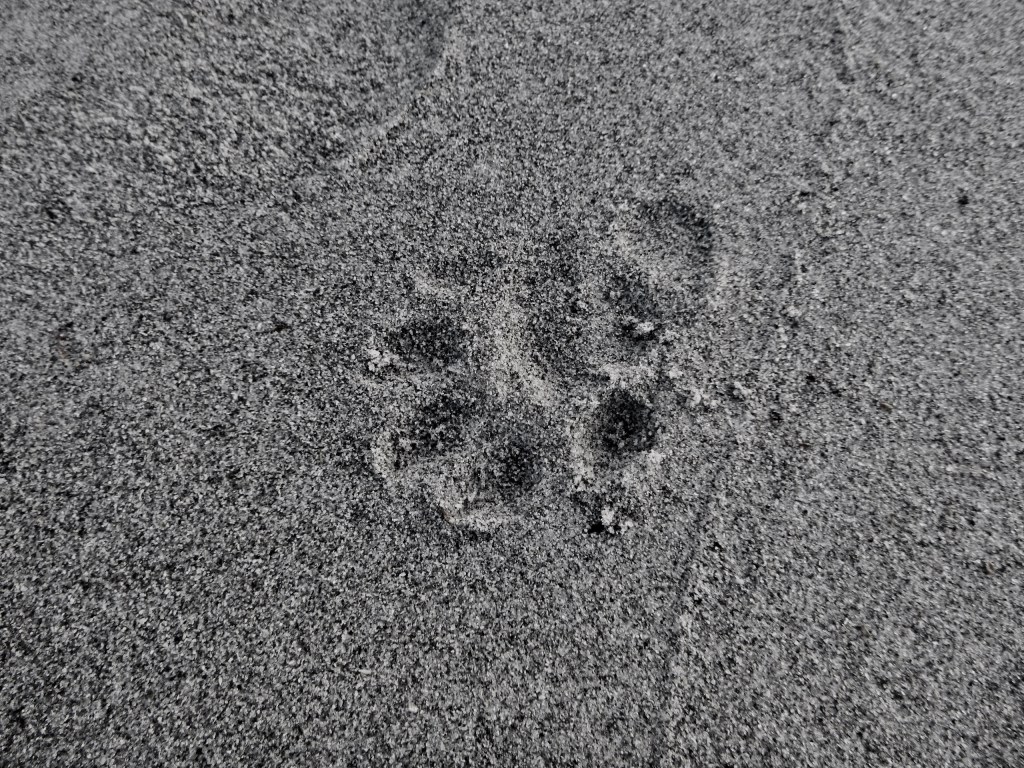
…which I think are from an otter. We watched two during our walk, fishing along the coast a few metres from the rocks. These tracks crossed a beach between two small bays, but then coincided with this next collection…

Dances with otters?
Predictably the fort we walked to – Dun Cragach – occupies a crag right on the sea. A dramatically raked hawthorn grows near the top and again there was little to see other than loose heaps of stone where was might once have stood.
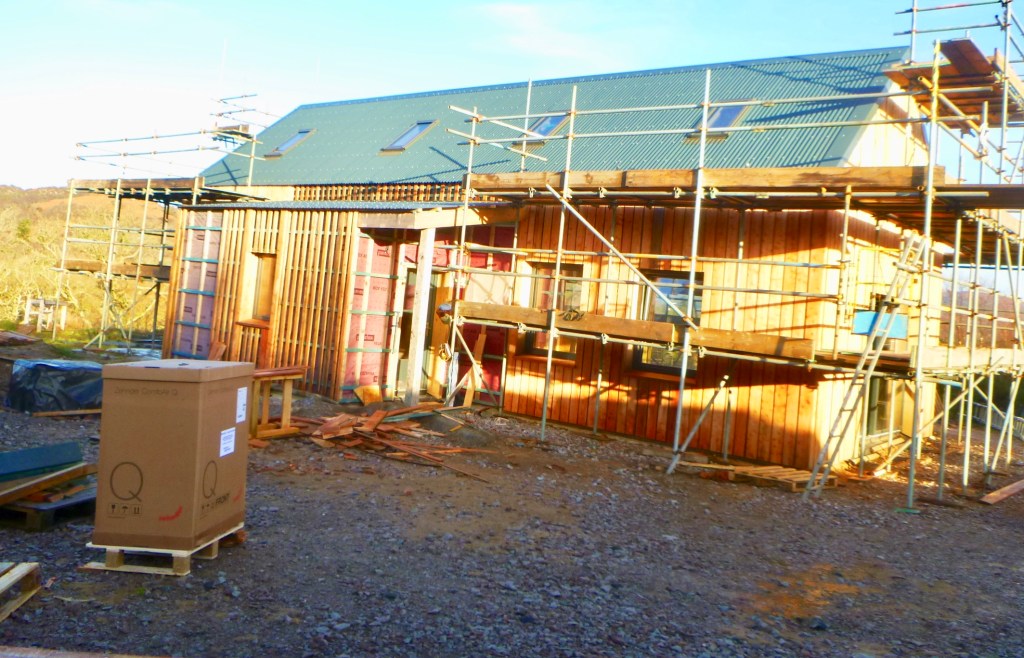
Back to the house: And back to work: the cladding on the house is SO NEARLY done! The only opening not to have the framing boards either side is the front door (being saved for a wet day as it’s under cover of the porch).

The entrance lean-to has its backing boards on but not those where the mechanical ventilation and heat recovery intake and exhaust and the air source heat pump will need holes in the wall. Today we started and finished the short boards over the lean-to, so tomorrow we can get on with fixing the facia boards which the guttering will fix to.

Once the facias boards are on I can start chasing the scaffolders as the scaffolding must go before I can cast the concrete slab for the air source heat pump…
And the Zehnder mechanical ventilation and heat recovery unit arrived this afternoon…
 A sustainable house for unsustainable times...