
After last week’s three days of landscaping I was pretty done in and took it easy on Thursday, with a bit of reading, writing and research. Recent weather has been fine, sometimes hot and with very little breeze. If the cloud thickens, breeze fades or the sun gets low the midges are likely to be out – out and biting. Apparently they can’t fly in winds of more than seven miles an hour, so wind speed is critical. At night, shut away from midges in our well sealed workshop, we’ve been rather too warm, reliant on an electric fan to keep stuffy air moving. Un-eco and uncomfortable. Tash bought several metres of fine, black midge netting and some extra head nets (though we have no extra heads) and we spent most of Friday making screens for two of the workshop windows.
The photo above is through one of the windows with the screen in place, the black netting almost invisible.
The frames we made from larch off-cuts, about 25mm wide, corners mitred, pinned and glued, the bottom rail bevelled to match the slope of the sill. With the frame face down on the floor we wrapped the netting up the sides and over the back, stapling it in place, trimming off the excess, then glueing the back and sides with PVA.

I thought we might need some draft excluder to seal between the frames and the windows but so far the midges have been kept at bay. Before we made the frames, midges were appearing in the shower room and I thought they could only be coming in through the ventilation fan, crawling through its foam filters. One of the extra head nets over the outside cowl of the ventilator proved a quick, if temporary fix.

The weekend passed with a little local kayaking on Loch Fyne and some raking and stone picking on the place for the bell tent.

Shower stuff. In the last two weeks the two identical shower sets have arrived, as well as a screen and a hinged ‘flapper’ for the wet room. Door, tray and drain are due in ten days. I thought I really should check the shower sets to make sure they were acceptable and would fit in the proposed locations. Each comprises a thermostatic mixer valve to be concealed in the wall, a round rain head, and a hand set with support rail. I was baffled. Brief pictorial instructions showed only the mixer valve (different model) and its components. The outlets for the showers are threaded where they penetrate the wall, but included a plastic nut to screw up behind the wall covering, clamping the outlet pipe in place – somehow assuming I would be able to get inside the wall to do this…

A day was spent pondering my purchase, holding the components in their respective locations (here, or… here?), watching videos and generally seeking answers. I came to the conclusion that I needed to forget the plastic nuts and buy a couple of brass wall plates to mount within the stud wall, to screw the outlets into; something like this…

…so I put together yet another order of all the plumbing fittings I thought I’d need to connect the outlets to the mixer valve and the mixer valve to the hot and cold supplies. For good measure I added a medium slinky toilet pan connector as the small one I had was a tad too short when I tried fitting it.

I wasn’t completely sure of my reasoning and called in Colin (one of) the retired plumber(s); he confirmed my thoughts. I rather wished I’d followed my neighbour’s example and bought a shower where the hot and cold are mixed in the plant room then sent via one pipe that can then come down from the ceiling in the bar that also supports the shower, very neat, but I shied away from making the plant room more complicated and am slightly distrustful of ‘smart’ technology. Looking at the plant room now I don’t know where it could have been fitted in, but I think it would have been a better solution. If anything goes wrong with my thermostatic mixers they’ll be buried in the wall under a layer of plywood and tiling…
For the past couple of weeks my main thought has been to enable commissioning of the heat pump. I’d spent a day in the plant room finishing the OSB internal cladding so subsequent (imminent) cabling could be fixed. To fit the final pieces I had to unclip some of the cables and pipes and reattach them afterwards – my last opportunity to tidy things up, making sure pipes had as many clips as they needed. In one place my inexpert copper plumbing was too close to the wall and a snaky saw cut was needed to fit the OSB in place…


On Wednesday afternoon the electrician and his ‘lad’ Arran finally came over for a look-see and Arran came back for the next day and a half, wired the heat pump, connected and ducted other plant room wiring and sorted out two small snags from before. Some essential components for the underfloor heating are missing, these ‘actuators’ screw on to the manifold and control the flow of hot water to the individual circuits. I’m hoping delivery has just been overlooked and realise I don’t actually know what is involved in commissioning the heat pump. A conversation with the heating engineer is overdue!


As well as electrics for commissioning the heat pump there is plumbing. I’ll have to connect the water supply to the house but at the moment all the pipe ends – where taps and appliances will be connected – have caps on. If the system is filled I won’t be able to remove any of the caps without turning off the supply and draining at least part of it. I added fourteen ’emergency shut-off valves/taps’ to my order and fitted them on Friday. Now I can connect whatever I need to the valve and open it when I’m ready; a quarter turn opens or closes.

But everything leads on to something else, if not several things. I had to decide where I needed the cut-off valves to be and I had to support and tidy the pipework with clips.
As part of my thinking about the showers I’ve been building the support for the ceiling over the upstairs shower. This is helping me visualise the space and think about where to place the rain head and hand set, as well as the mechanical ventilation extractor and downlighter. To prepare for fitting and plumbing the shower mixer I had to remove the sheet of ply I’d cut and screwed with a zillion screws but at least this momentary backward step was not destructive. Popping it back will take ten minutes.
Stairs. Prompted by friend David I’ve decided to get on and order a staircase, hoping to fit it myself, with the help of a carpenter neighbour who owes me a day’s work. Stairs would make working upstairs quicker and make moving materials up and down much easier. Just when I’ve thought I’d settle to the task and get quotes more urgent work has intervened. Next week perhaps? Stair Box and Pears Stairs come architect recommended, with TK stairs a possible option.
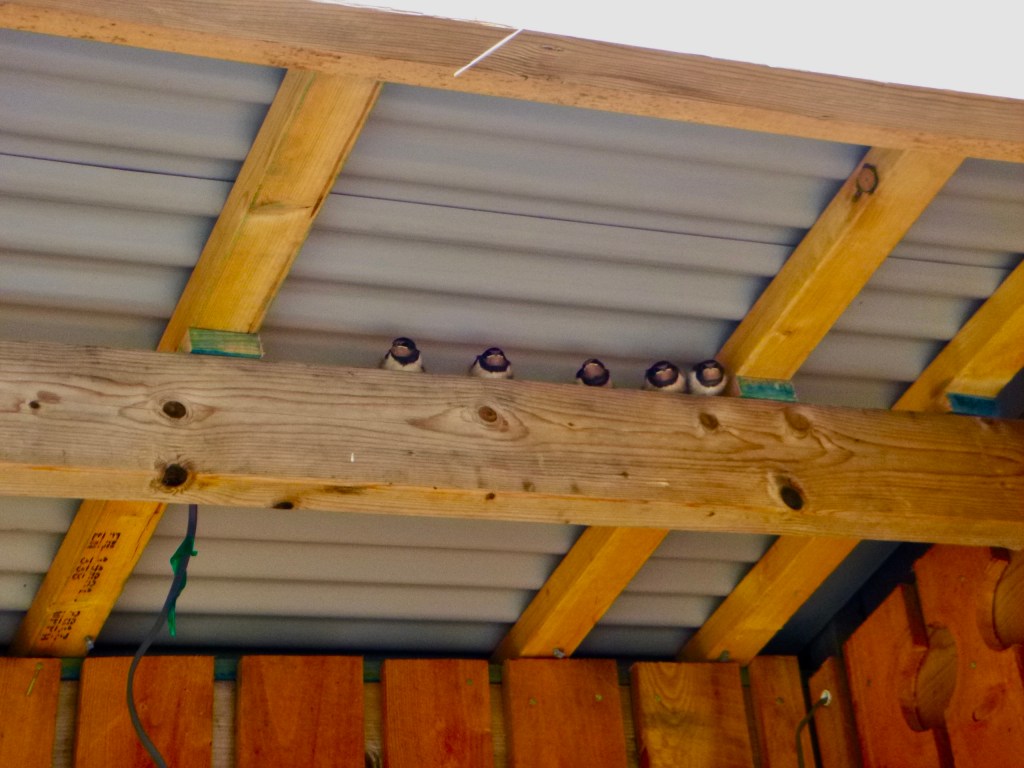
Swallows. As mentioned in a previous post, swallows inspected our porch but nested on our neighbours’ house, who yesterday reported watching the young leaving the nest.
All afternoon the swallows were swooping round our plot and at half past nine they were roosting in the porch. At eight thirty this morning they’re still there. We’re thrilled by their presence but Nutmeg is anxious. The swallows dive bomb her and she rushes indoors looking sheepish. The tables have been turned.
 A sustainable house for unsustainable times...