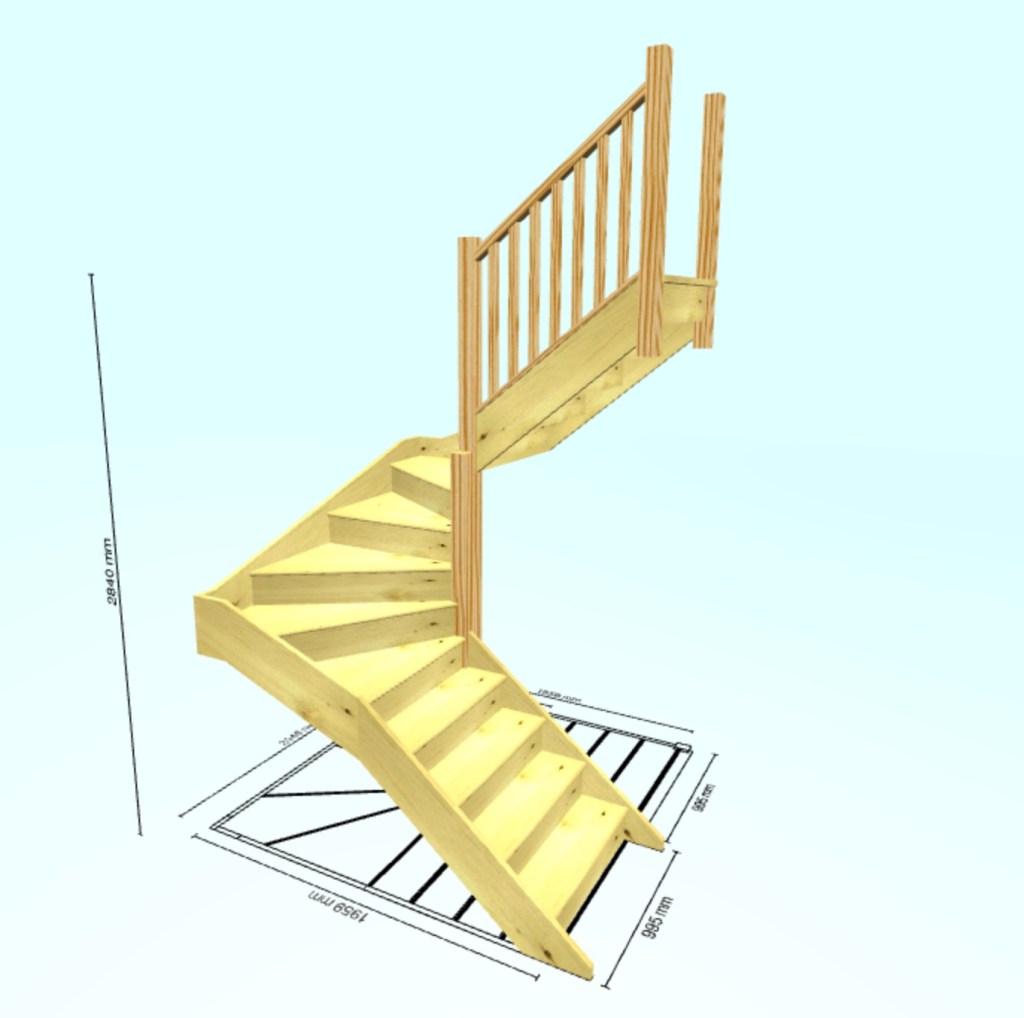
Tuesday. I’m waiting for the stair man to ring me back. Yesterday and today have been dominated by the internet on screen. It really does make sense to get the stairs in to ease working on the first floor, as David has been trying to tell me for weeks. Not only will it be quicker and easier to move materials – consider moving an easily broken whole sheet of plasterboard up a ladder, singlehanded – but safer too. There are several websites where, by answering simple questions, you can build a representation of the stairs you think you want on the screen in front of you and see the price go up or down, accordingly. Two of these sites that I’ve used (Pears Stairs and StairBox) produce not only a plan but also a virtual 3D model of your stairs so far , which you can turn, tilt and enlarge to inspect your handiwork.
After drawing many flights of stairs that I intended to build I was finally swayed by the challenging tsunami of tasks I still have to face and the ease of having an expert do it for me. With the cost of materials and the time I’d take I doubt that doing it myself would be much of a saving, though the challenge was intriguing. I still intend to install them myself, hopefully with at least one pair of semi-expert hands. I’ve taken the best part of two days to get to the point where I’m happy to make my order; much of the time has been spent considering details, both practical and aesthetic – how will the landing balustrade meet the sloping ceiling – do I want extra noses and aprons – must I have 41mm spindles (32mm would look better) – is the handrail too chunky or too fussy?

Both I, and the websites I’ve used, make assumptions that are not immediately apparent, so you can – and I very nearly did – buy something I didn’t quite want. These are the things that I’d notice when I come to fit the stairs, things that given a little more education I might have seen in time, things that don’t necessarily show up in that clever but limited 3D model. I thought I had a clear idea in my head but in reality there were (are?) many details missing.
My stairs will be in a stairwell, enclosed by walls on three sides – up four steps on the left, wind round to the right 180 degrees then straight up another four steps to the landing. Two sides will need some landing balustrade. The treads (horizontal) and risers (vertical) are held together and supported by a large board on either side called a stringer. Where this is against a wall it forms what you might take for a piece of skirting, but where the edge of the staircase is exposed to view it would hide the edge of the treads; just a big sloping board. I realised that walking up the first flight this is what I’d see of the second flight, a big diagonal board. Both Tash and I would rather see the zig-zag of treads and risers. This is a common feature of stairs in a Georgian or Victorian hallway, but how often does one actually stop to consider it (apart from builders and architects, who do it all the time)? So yet again I phoned and asked about having this particular feature – a ‘cut stringer’. No problem, I was told. I struggled repeatedly with my reluctance to phone and talk to the same person about yet another thing I’d only just thought of.
So I took more measurements, did some extra chin-scratching and sketching, phoned the man again and got a final quote. I’ll sleep on it and buy the stairs in the morning.

Wednesday. It’s not all stairs. I’ve ordered the five hundred litre water tank with integral pump and a diameter of 760mm – represented by the cardboard disc in the photo above. It will need a(nother) concrete base slab to be cast and a frost-proof shed on top, to ensure the sensitive electronic controller is not damaged.
The stairs and the wood burning stoves should arrive at about the same time, in about three weeks.

Not really necessary in a near-passive house and not a great idea in terms of holes in the super-insulated, airtight fabric of the house (for air intake and flue), but apart from the emotional comfort of looking at a fire, what if the North Atlantic Drift breaks down? What if we are without electricity for a few days?
Friday. Yesterday I only managed to work until lunchtime, then could hardly keep my eyes open. I’d managed to cut and fit some more lining pieces to make the skylights airtight again, but the thermometer read thirty degrees in the shade. After lunch a siesta took me until five thirty, when I joined Tash, releasing her inner mermaid in West Loch Tarbert; now, even for a skinny old bloke, the loch is no longer cold.
Today – not quite as hot, but working was out of the question as we’d accepted an invitation to sail to Gigha with some inspiring neighbours, making the most of the weather and their as-yet-unsold boat. At seven thirty whitevanman scrunched down the drive to deliver the shower screen door and when we got home the water tank was waiting patiently by the workshop.

 A sustainable house for unsustainable times...